
Why did I do it?
I’ve been devotedly focused on overcoming Mast Cell Activation Disorder for nearly five years now. In addition to many other symptoms, I tend to bloat throughout the day, everyday, even when on a five day water fast.
One explanation for this is that my mast cells react to the expansion of my stomach that occurs when anything is added to it (including water). An alternative theory is that countless courses of antibiotics have disrupted my gut microbiome, leading to leaky gut (intestinal permeability). Therefore, drinking water (or eating anything) causes more particles to cross my gut lining and enter my blood stream, so my immune system (specifically, my mast cells) activates and attack the intruders.
Also, I have eczema on my wrists, perhaps triggered by wearing a wristwatch and exacerbated by the incessant corona-focused hand washing we all do these days.
I’ve done low histamine, SIBO, Low FODMAP and low protein diets: all the colours in all the sizes. I’ve had courses of antibiotics and rounds of herbal antimicrobials, and many pro- and prebiotics in an effort to balance my gut microbiome. I was already doing a low-lectin, low-histamine, low-oxalate, gluten-free, grain-free, seed-free, nut-free (apart from coconut), cyclical ketogenic diet.
So, what’s next?
I’ve been thinking about the carnivore diet for a while now: there’ve been successes improving mast cell activation disorder with it (see @wholebodyhealingwithjen on Instagram).
Last year, when I did a five-day water fast (a topic for a separate blog post), the only thing that improved was the eczema on my wrists. Clearly diet was a factor so, whilst excluding all food improved my wrist, no food at all isn’t sustainable. So what would happen if I tried a carnivore diet as a strict elimination diet/modified fast for five days?
After 5 days the results were encouraging, so much so that I’ve continued for the entire month.
I should add that having recently read Dr. Stephen Gundry’s “The Plant Paradox”, (a less extreme version of the carnivore diet), I realised that I had already cut out all the foods that he suggests removing but I was still experiencing symptoms. So, in reality, I did not have much more to cut out before going fully carnivore.
How did I do it?
At this point, I must reference and thank Dr. Paul Saladino for his, “The Carnivore Code”: it’s been an invaluable guide, as has his podcast, “Fundamental Health”. His proposal is that a “nose to tail” approach (i.e. include all of the organ meats) is the most nutrient-dense way to eat.
My initial experiments of leaping straight in to the diet weren’t terribly effective, so I’ve modified my approach somewhat.
Eating heart and chewy bits of steak had a major drawback: not much nutrition if you throw up! Therefore, I’ve substituted desiccated organ meat supplements for the actual organs and found that gradually increasing the extent to which I eat the trimmings on steaks has increased my tolerance. I grew up eating chicken breast fillets so, this has been quite an adjustment!
I will reintroduce organ meats (liver, heart and kidneys), mixing them in with ground meat.
I do agree with Dr. Paul that both dairy and rendered fats can be problematic but I have found both to be useful for allowing me to get more calories but with less volume (as the volume tends to cause reactions). Coming into the carnivore diet, my appetite was low, and the food volume I could tolerate was modest so, for the first few days, I consumed very few calories (as low as 900 one day). There are benefits to this but for me, it leads to fatigue, brain fog, cold intolerance, irritability and greater inflammation from mast cells reacting to the stress.
Therefore, I found that having some camel milk (A2 casein) was crucial at the start of the diet to allow me to get enough calories. I have removed it from my diet, and then reintroduced it many times so I feel that it is “safe” for me from an immune point of view. In addition, I understand that Dr. Paul’s main objection was that it can cause people feel less satiated: as I was aiming to eat more and feel less satiated, this wasn’t a problem!
Thankfully, the volume of food that I have been able to tolerate has increased over the last month. I now only include the camel milk on days when I deliberately wish to increase carbohydrates (it has a fair amount of sugar), when I’m more physically active. However, I do still find that unless I cook each meal in a tablespoon of tallow, and then add about a tablespoon of ghee to the food itself (a sort of dressing), I fall short of my caloric needs, and suffer the consequences the following day.
If I am seeking to include some carbohydrates, then my sources have been blueberries or butternut squash (peeled and de-seeded). Fortunately, I tolerate these well. I occasionally add honey but it’s been a trigger in the past, so I minimise this. I aim to have around 65g of carbohydrates to bring me out of ketosis. I tend to have these all in one meal at the end of the day, so that the resulting blood sugar spike and fall coincides with me heading to bed (being more sleepy anyway) and I’m not then seeking more sugary things to bring my blood sugar back up.
I know that Dr. Paul would encourage eating fattier cuts, along with suet and bone marrow and I’ll aim for that. However, for now, the gentle introduction works better for me so far. I’ve supplemented my diet with 15g glycine per day, a conditionally essential amino acid found in collagen (in ligaments, tendons, and skin) which I am probably not getting enough of from my food.
What have the results been?
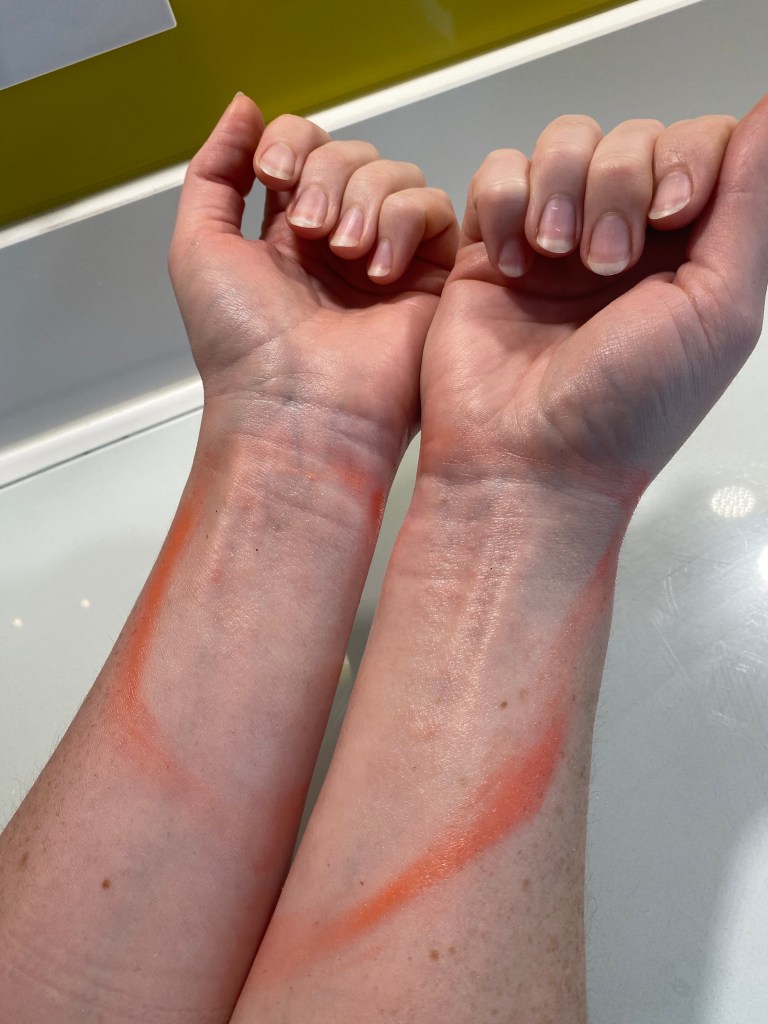
You can see in the photo the red lines I’ve drawn showing where the edges of my eczema used to be. It’s now nearly entirely gone: my skin is no longer red and irritated; the only remnants being a few patches of slightly drier skin.
As noted at outset, before starting the carnivore diet, I bloated throughout the day. Now, I bloat perhaps 1% of the extent that I used to, and even then, only briefly after meals, rather than for hours. I can’t say my digestion has yet completely adapted to the carnivore way of eating, but I am hopeful that this period of adjustment means that good things are happening.
Another persistent symptom for me has been sinus congestion, which I have termed “snifflyness” in my notes. I often have a runny nose and some “clagginess” in my throat. Frustratingly, this has yet to resolve. However, it has significantly improved to the extent that I can now sleep without snoring: a first in the five years I have tracked it and perhaps for the first time in my life! I do still find that I have to blow my nose each time I eat food. I am currently attributing this either to continued mast cell reactions each time I eat, or to the saturated fats that I’m eating helping any lipopolysaccaharides in my gut cross into my blood stream and causing systemic inflammation. It is improving, and so while the bloating and eczema also improve, I hope it continues to do so.
Keeping my calorie levels high, I find I have more energy (which is fantastic) and greater stamina. I also sleep more, but hopefully this is due to the healing, evident in my skin and hopefully reflective of internal healing of my gut lining.
In addition to the eczema, I was previously plagued with acne that was so severe that a dermatologist wanted to put me on Roaccutane. Now my skin is clear of spots (there’s a sentence I never thought I would say!). I have in the past particularly had hormonal acne (along my jawline) during the luteal phase of my cycle. Despite what many say about the negative effects of low-carbohydrate diets on women’s hormones, I have not seen negative effects yet. I did have some mid-cycle spotting, which is not usual for me, so I increased my carbohydrates every evening until that stopped. But even my hormonal acne has almost completely disappeared.
Over the past month, I have lost 3.4kg, perhaps indicative of reduced inflammation. I initially lost more and have put some back on as I have been able to tolerate more calories. I have not been seeking to lose weight at all: I am actually looking to put on more muscle and get stronger (muscle weighs more than fat so perhaps a modest gain arises in consequence). I’ve also seen improvements in the weights that I am able to lift and in my physical fitness generally. In addition to all this, for the first time in my life, I am able to run (not that I run far) without any joint pain.
I have halved my dose of Sodium Cromoglicate (with the support of my doctor), a mast cell stabiliser, originally prescribed for stomach pain when I ate. I now have no stomach pain when eating, and only minimal bloating, so I’m reducing my dose and seeking to come off it completely.
Will I continue with it?
I’m not sure that I’m entirely convinced that a solely carnivore diet is necessary for optimal health forever. Moreover, I am not someone who does well thinking in those terms: if I tell myself that I can never have something again, that tends to make me want it far more. I am already beginning to think about how I can have some blueberries (and maybe make myself some sort of baked goods) for my birthday.
However, I cannot deny that for the moment, this is working fabulously well for me, at least as a strict elimination diet. My inclination is to continue at least until my wrists are completely healed and free of any eczema. Once I am at that stage, I may seek to reintroduce some plant foods to my diet, but I suspect that I will remain more focused on animal foods than I have been in the past.
It has been convenient to do this during lockdown, when I am not eating out with friends or family and so able to entirely control my food. Once normal life resumes, it is normal for me to eat out every weekend and so I may find that I balance being more strictly carnivore during the week and relaxing with plant foods that I tolerate at weekends.
As ever, I finish excited by my progress, keenly aware of how much further I have to go, and hopeful that this is a giant leap in the right direction.
I know that for many with mast cell activation disorder, we are told that the best we can hope for is to find the right balance of immune-suppressing medication to allow us to limp through life. But I’m already getting better, so it is possible. What works for me may not work for everyone, especially with MCAD, but if you keep trying different things, eventually you will find what works for you too.
 Thriving Not Surviving